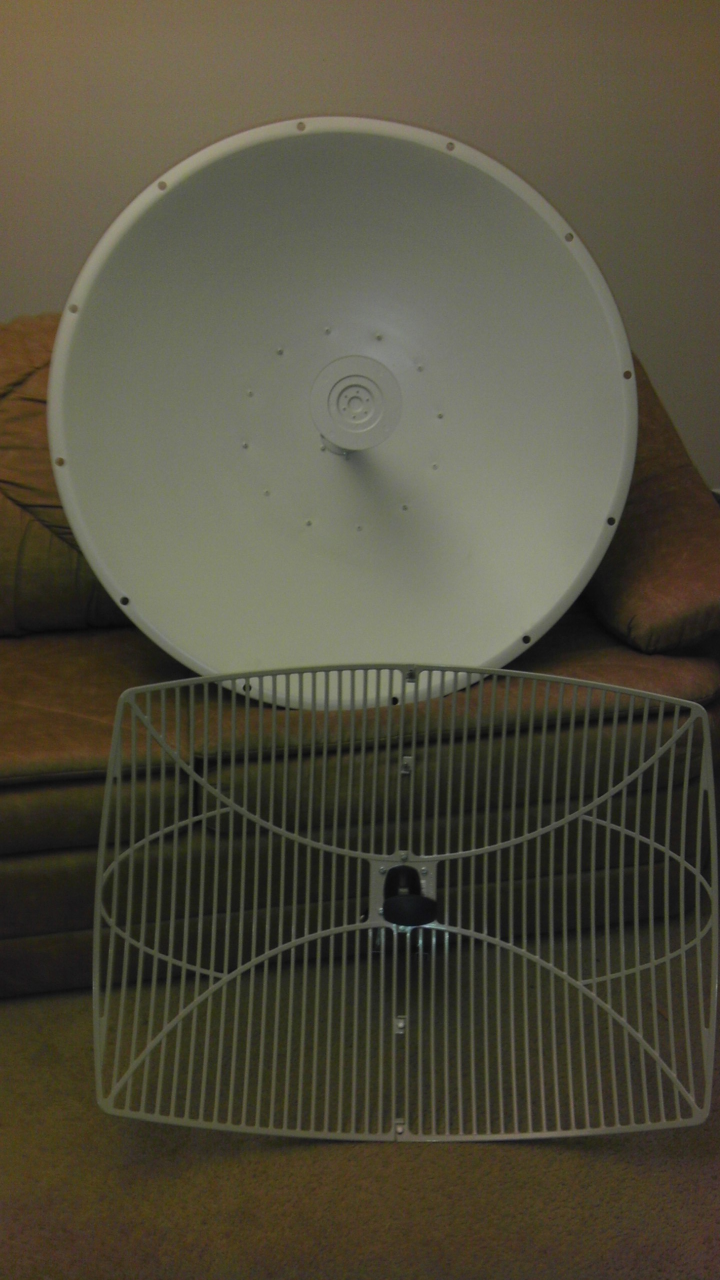
Hello, Did some more antenna measurements tonight. The Ubiquiti sectors were the new contenders for the "official sector" title. The 5G-16-120 <https://www.hamwan.org/t/tiki-index.php?page=Ubiquiti+5G-16-120&structure=HamWAN> didn't do so well. Gain is dreadful and the radiation pattern is nearly omnidirectional. Blah! The 5G-19-120 <https://www.hamwan.org/t/tiki-index.php?page=Ubiquiti+5G-19-120&structure=HamWAN> did a lot better. It looks to be a 90 degree sector though, if we're honest. -3dB points were measured just 81 degrees apart. The +/- 60 degree points look to be -8dB, not the -6dB I've come to expect from some manufacturer beamwidth claims. The radiation pattern is also a bit weird in its shape, but not awful. The frequency response is pretty good though. The final drawback of this sector is price. It's about $150 a piece. Although that is cheaper than the Laird sector which is $180 a piece. This Ubiquiti sector is also dual polarity, so if we ever do MIMO, antennas won't have to change. More contenders have arrived though! I'll get them tested soon. Hopefully they blow all these expensive sectors out of the water. :) Now, on the "official high gain antenna" front, I've measured two new contenders as well. The ARC-DA5834SD1 <https://www.hamwan.org/t/tiki-index.php?page=ARC+ARC-DA5834SD1&structure=HamWAN> does not disappoint. It is well constructed and weighs less than you'd think. The frequency response is the flattest of ANY of the antennas tested so far. The radiation pattern is THE most directional of any of the antennas tested so far as well. Just look at that gorgeous rejection, all at least -30dB down. This is the #1 choice if you've got the $300 (shipped) to spend on it. It is also a dual polarity antenna with a fair amount of isolation between the polarities. On the rear are N-connector to waveguide adapters. They combine to feed one solid circular waveguide that protrudes from the center of the dish. At the end of the waveguide structure the metal turns to plastic and the waves are allowed to radiate through the plastic shield/support onto the subreflector at the very tip. This subreflector has a really cool wavey pattern milled into it on the underneath to collimate all the waves properly to/from the main reflector dish. I found the N connectors somewhat hard to start threading for whatever reason. Was not getting alignment. The mounting system is well thought out and a pleasure to use, especially to adjust the tilt of the antenna! You just turn one nut to raise/lower the tilt. To rotate you can loosen both U-bolts. Now, normally this would make the antenna slide down. But they're thought of that and provide you with a stopper you install on the mast before hand. The weight of the antenna rotates on this base. When angled right, you just tighten the antenna's u-bolts. There's also a built-in mini-mast section to bolt a radio to. Very well thought out. A very nice antenna. But still, $300 shipped from Streakwave isn't cheap. WLANmall looks to have it <http://www.wlanmall.com/arc-34dbi-dual-pol-4-94-5875ghz-dp-dish.html> for much less shipping. Streakwave tried to jack the shipping on this antenna by another $50 *after* I placed the order. It would have been $350 if I let them have their way. The Poynting K-GRID-003-06 <https://www.hamwan.org/t/tiki-index.php?page=Poynting+K-GRID-003-06&structure=HamWAN>, henceforth known as "Die Antwoord <http://en.wikipedia.org/wiki/Die_Antwoord>", is a surprisingly well performing high gain antenna. It is designed and manufactured in South Africa <https://maps.google.com/maps?hl=en&ll=-26.10403,28.079563&spn=0.012689,0.009495&sll=-26.103982,28.079655&layer=c&cid=11252272406233210136&cbp=13,3.3,,0,2.79&panoid=inPysFz8CF29sKnrYx1ziw&gl=US&t=h&z=17&cbll=-26.104026,28.079467>, just like its musical namesake. It may indeed be "the answer" for HamWAN's directional antenna needs. While I do not have official trustworthy absolute gain comparison figures yet for any of the antennas, the preliminary numbers make it look like Die Antwoord gets about 5dB over its similar-in-size cousin, the Laird GD5W-28P <https://www.hamwan.org/t/tiki-index.php?page=Laird+GD5W-28P&structure=HamWAN>. It also looks like the $300 dish is only 1dB better. Die Antwoord also features a much flatter frequency response, and a far better radiation pattern than the Laird. You know you're doing something right when the manufacturer's published H-plane pattern <http://cdn.entelectonline.co.za/wm-43814-cmsimages/A-K-GD-003-06%20Datasheet.pdf> strongly resembles your own results. Notice the distinctive side-lobes touching -20dB on either side of the main lobe. Notice the containment of all other lobes within the -30dB limits. This is a FINE antenna! And for not lying about the patterns like so many others do, Poynting gets my "fine manufacturer" seal of approval. Poynting and I disagree on the frequency response, but the difference is 1dB, so I'll let it go. :) The gain is really quite flat. A surprising achievement for such a broadband antenna. In fact, the gain flatness is only bested by the $300 ARC dish mentioned in the previous paragraph. What does all this wonderful performance cost? Would you believe a mere $95 shipped <http://www.titanwirelessonline.com/Poynting-5-8GHz-31dBi-Grid-p/at-30gr-58.htm>? NOTE: Do *NOT* follow the advice of the one gentleman who commented on this product at the link I just gave you. The man is a fool who ruined his antenna. :) The radiating element is meant to be unconventionally oriented. Follow the assembly instructions. The physical size difference between the $95 Die Antwoord (bottom) and the $300 ARC dish (top) is small. Here they are both enjoying my couch, just yearning to RF @ each other: To truly measure the real long distance gain of these antennas, I've got to test them over a longer range. Something like 100m should be enough to make the EM waves mostly perpendicular to the DUT antennas instead of hitting them at weird angles. This straightening of geometry should allow for real-world gain measurements and comparison of absolute gain performance. A 3ft dish on a 20ft range may not get the chance to focus correctly, and it may be losing gain because of this. I've taken steps so that I can take the measurement lab mobile and deploy in a large field. I also screwed up the measurement process enough times that I finally sat down and documented it, step-by-step, at the bottom of the Antenna Analysis <https://www.hamwan.org/t/tiki-index.php?page=Antenna+Analysis&structure=HamWAN> page. Who could possibly screw up executing a 57 step sequence from memory? :) Finally, I also had a discussion with a microwave antenna measuring friend of mine, and figured out how to measure the absolute gain of each antenna. This is different from measuring "comparison of absolute gain", aka "absolute gain delta between antennas". This would be deriving that actual dBi you'd print on a box of a product and you'd have to stand by it. I'm not sure if the process is worth it though, since it's only the deltas which lead to antenna selection decisions. We'll see. Now, where are those new sectors ... --Bart